
Introduction: Why Your Global Payment Strategy Fails in Southeast Asia
For any business with global ambitions, Southeast Asia—with its 600+ million people and a booming internet economy—is an undeniable sea of opportunity. However, many ambitious companies find their growth falling far short of expectations after entering this market. The reason often lies not in their product or marketing, but in a more fundamental yet fatal area: payments.
Directly copying the successful, international credit card-centric (Visa/Mastercard) payment strategy from Western markets to Southeast Asia is a common pitfall. This “one-size-fits-all” approach ignores a fundamental truth: Southeast Asia is not a single, unified market, but an “archipelago” of multiple, hyper-local, and unique payment ecosystems.
Here, a payment method is not a simple technical option; it’s a deep reflection of local culture, business customs, and digital lifestyles. This article will delve into the core characteristics of Southeast Asian payments, analyze the universal challenges faced by global merchants, and explain why an infrastructure capable of deeply integrating local payments is the prerequisite for winning this market.
The DNA of SEA Payments: One Country, One “Universe”
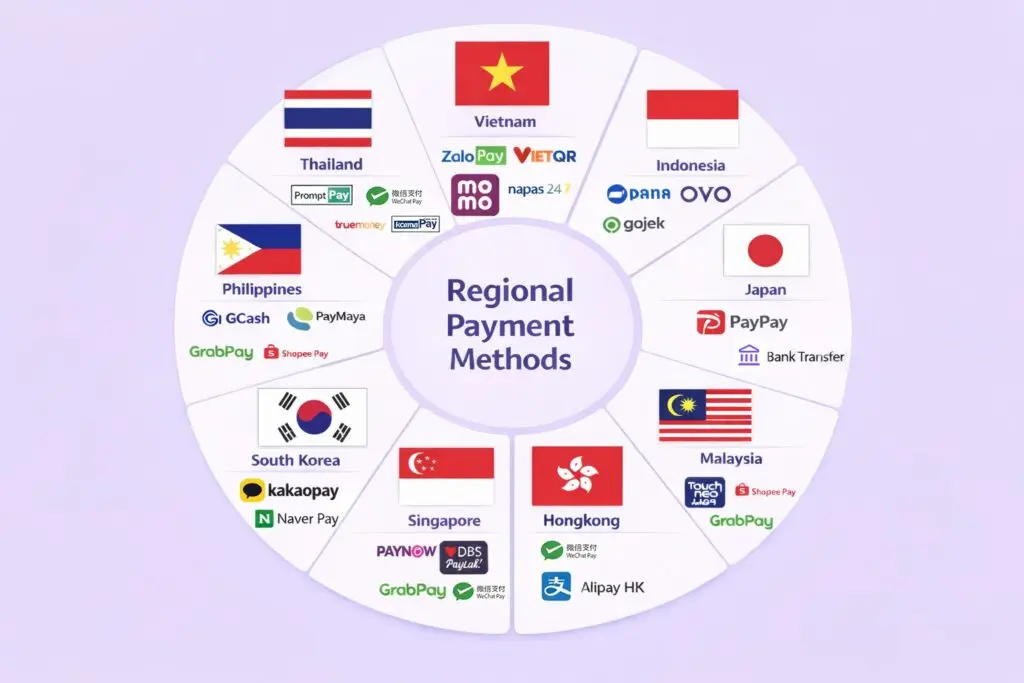
Unlike other regions, digital payments in Southeast Asia are not monopolized by a few international giants. Instead, driven by “super-apps” and government-led real-time payment networks, each country has formed its own distinct payment “universe.”
- The Rise of Real-Time Payment Networks: In Thailand, the central bank-driven PromptPay has become a national payment standard, with transaction volumes far exceeding cards. Similarly, in Singapore, PayNow plays a comparable role. These systems make instant bank-to-bank transfers as simple as sending a text message and are widely used for all types of online and offline payments.
- The Absolute Dominance of E-Wallets: In Indonesia, the Philippines, and Malaysia, e-wallets are the undisputed kings. “Super-app” wallets deeply integrated with high-frequency services like ride-hailing, food delivery, and e-commerce—such as DANA and OVO in Indonesia, GCash in the Philippines, and Touch ‘n Go eWallet in Malaysia—command a massive share of online transactions.
- The Ubiquity of QR Codes: In Vietnam, mobile payment providers like ZaloPay and MoMo have brought tens of millions of users into the cashless era through a nationwide network of QR codes (like the VietQR standard). Scanning a QR code to pay has become muscle memory.
The Core Insight: In Southeast Asia, a consumer’s preferred payment method is rarely an international credit card. If your checkout page fails to offer the local options they know and trust, you are, in effect, actively turning away the vast majority of your potential customers at the final step.
The Three “Hidden Reefs” in Global Merchants’ Operations
Faced with such a fragmented landscape, global merchants often hit three “hidden reefs” when trying to solve the problem themselves, leading to soaring operational costs and stalled market expansion.
- The “Bottomless Pit” of Technical Integration: Undertaking separate technical integrations for each country’s multiple mainstream payment methods is an incredibly complex engineering feat. This involves not only huge upfront development costs but also ongoing maintenance, API changes, and troubleshooting, which consumes valuable engineering resources.
- The “Nightmare” of Financial Reconciliation: Imagine your finance team having to process completely different statement formats in Thai Baht, Vietnamese Dong, and Indonesian Rupiah every month. This makes fund reconciliation, cost allocation, and profit calculation exceedingly difficult, severely impacting financial efficiency and decision-making accuracy.
- The “Labyrinth” of Local Compliance and Fund Management: Establishing local entities, opening bank accounts, handling taxes, and navigating foreign exchange controls in each target country is a costly and cumbersome legal and financial challenge. For most businesses, this is a nearly impossible task.
WooshPay’s Solution: Simplifying Complexity, Conquering SEA with One Platform
To conquer the complexity of the Southeast Asian market, you don’t need more local channels; you need a “unified command platform” that can integrate everything from a higher dimension. This is the core value WooshPay offers to global merchants.
- One API, Connecting All of Southeast Asia: Through WooshPay’s single API integration, you can instantly offer consumers in all your target countries their most familiar and preferred local payment methods. Our smart checkout can also automatically detect the user’s country and prioritize the corresponding payment options, thereby maximizing your payment success rate.
- One Dashboard, Clarifying All Fund Flows: Say goodbye to chaotic multi-currency reconciliation. All transactions completed through WooshPay, regardless of the country or payment method, are presented in a clear, standardized format in your unified dashboard. Your finance team gets a bird’s-eye view of your entire SEA revenue, making reconciliation effortless.
- One Partner, Solving All Local Hurdles: WooshPay acts as your “local representative” in each Southeast Asian country, compliantly handling all local currency collections and complex cross-border fund settlements for you. You can easily receive your earned local revenue in your preferred currency, such as USD or EUR, without needing to establish local entities.
Conclusion: Turn “Local Payments” from a Growth Barrier into a Core Advantage
In Southeast Asia, the ability to offer a localized payment experience is no longer a “nice-to-have”; it’s the “survival line” that determines success or failure.
A passive, country-by-country manual approach will only get you lost in complexity. The proactive, strategic choice is to partner with an infrastructure provider that deeply understands and has already solved this complexity.
With WooshPay, you can transform the biggest challenge of “payment localization” into your core competitive advantage, enabling you to enter markets faster, operate more efficiently, and ultimately, confidently win the world’s most dynamic digital economy.