
Introduction: Are You Still Paying a Premium for “Outdated” Efficiency?
In the race for global business advantage, we obsess over optimizing every detail: more efficient supply chains, more precise marketing, lower production costs. Yet, many businesses overlook one of the most fundamental and costly aspects of their operations: the movement of cross-border funds.
We’ve grown accustomed to international wire transfers taking 3-5 days. We’ve accepted losing 2-3% on foreign exchange spreads. We’re used to paying high bank fees for complex Letters of Credit. We treat these as “the necessary costs of doing business.”
But what if there was a way to shrink those 3-5 days to 3-5 minutes, reduce that 2-3% FX loss to near zero, and automate complex trust processes? If such a way exists, then continuing with the old method constitutes a massive “opportunity cost.”
In 2026, stablecoin (e.g., USDC, USDT) payments are no longer a future “concept.” They are a mature, efficient, and extremely low-cost global payment option. The question is no longer “Should we try it?” but rather, “How much money are we losing every day by not using it?”
Redefining “Cost”: The Three “Efficiency Black Holes” of Traditional Payments
Let’s re-examine the costs we’ve become “accustomed” to in traditional payment methods:
- The Time-Value Cost of Money: Every payment in transit is valuable cash flow that lies frozen. During the long waiting period, these funds, which could have been used for investment, procurement, or operations, are silently generating opportunity costs. For businesses with frequent transactions, this accumulates into a significant, though invisible, loss over time.
- The Volatility Risk Cost of FX: The foreign exchange market is volatile in the time between a transaction and its final settlement. Any unfavorable movement can directly erode already thin profit margins. To mitigate this uncertainty, businesses often incur additional expenses to purchase financial derivatives for hedging, further increasing their financial burden.
- The Process and Intermediary Cost of Trust: When establishing cooperation with new partners, businesses must rely on traditional tools like bank Letters of Credit to ensure transaction security. These instruments not only involve cumbersome and time-consuming processes but their substantial fees also directly increase the cost of a single transaction, reducing the flexibility and efficiency of commercial partnerships.
When you add these three up, you realize that the “invisible costs” of traditional cross-border payments far exceed the visible wire transfer fee.
Stablecoin Payments: From “Alternative” to “Optimal Solution”
Stablecoin payments have become the solution because they directly address the three core pain points mentioned above:
- Near-Zero Time Cost: Stablecoins move on global blockchain networks, settling in minutes. This shrinks the fund transit time from “days” to “minutes,” massively liberating a company’s cash flow.
- Controllable FX Risk: Because stablecoins are pegged 1:1 to fiat currencies like the US dollar, they have minimal value fluctuation during a transaction. Businesses can receive stablecoins and choose the optimal time to convert them, putting control of the exchange rate back in their hands.
- Automated Trust Mechanisms: Through smart contracts, functions like “automated escrow and release-on-delivery” can be easily implemented. This transforms complex, bank-intermediated trust processes into low-cost, automated programs executed by code.
You might ask: Is this ecosystem truly mature and reliable?
The answer is a resounding yes. As the “Stablecoin Stack Landscape” map illustrates, stablecoins are far from being a few isolated projects.
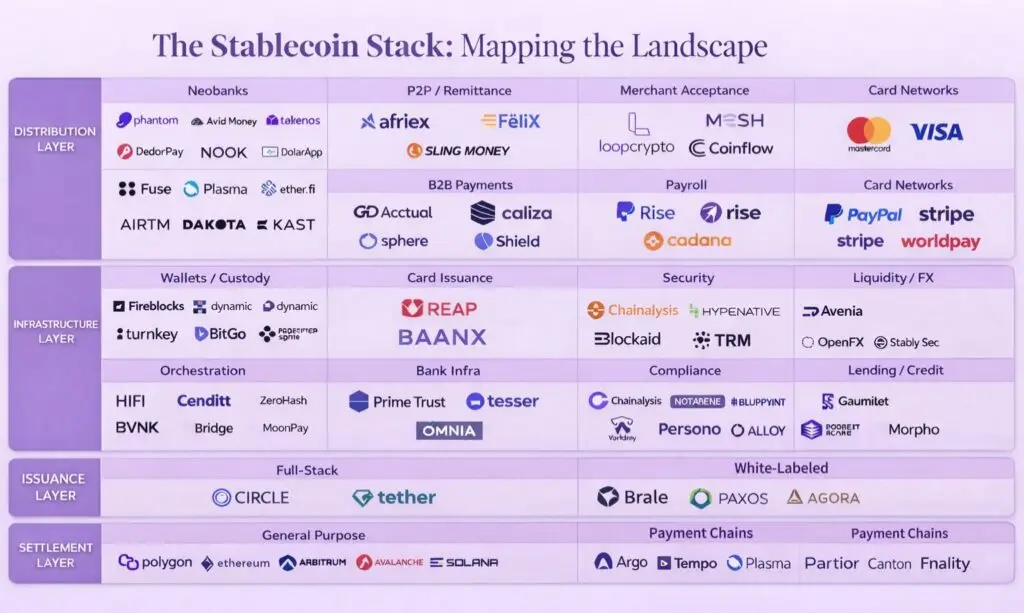
From the foundational Settlement Layer (e.g., Polygon, Solana) and the central Issuance Layer (e.g., Circle, Tether), to the vast array of Infrastructure Layer providers (covering wallets, security, compliance, liquidity, etc.), a complete, complex, and specialized professional ecosystem has already been formed. It functions much like our familiar traditional financial world, with its own “highways,” “central banks,” and various professional service firms.
The complexity of this ecosystem is, in fact, proof of its maturity. But this also raises a new question: How can a business navigate this complexity?
WooshPay’s Role: Your “Stablecoin Ecosystem Navigator”
Faced with such a vast technical stack, a business does not need to—and should not—build it all themselves. The right strategy is to choose a professional “navigator” to help you plug into this ecosystem with ease. This is the core value of WooshPay.
- One-Stop Access: We have already done all the hard integration work for you. Through WooshPay, you gain one-stop access to all the core capabilities of this mature ecosystem—from secure fund custody and compliant transaction monitoring to deep liquidity for conversions.
- Seamless Fiat-Crypto Conversion: Your customers can pay in their local fiat currency, and you can choose to receive funds in stablecoins, or vice versa. WooshPay handles all the complex conversion and settlement processes in the background, providing you with a silky-smooth, fiat-like experience.
- Enterprise-Grade Security and Compliance: We abstract away the complexities of private key management and security risk control, providing you with enterprise-grade protection. At the same time, we ensure your every transaction adheres to local regulatory frameworks, giving you complete peace of mind.
Conclusion: Stop Paying the “Outdated Premium” and Embrace Next-Generation Efficiency
In the business world, when a new technology’s efficiency and cost advantages reach a certain tipping point, continuing to use the old technology is no longer “prudent”—it’s a “regression.”
Stablecoin payments have crossed that tipping point. They are no longer a future trend to be watched, but a present-day tool that can immediately save you costs, boost your efficiency, and build a competitive advantage.
Choosing an infrastructure partner like WooshPay means you can immediately stop paying the high invisible costs for “outdated efficiency” and easily integrate the next generation of global payment infrastructure into your corporate operating system.